Service · cold, ice, minutes
How to chill 50 bottles quickly?
In a tub of water, ice and salt: twenty minutes per bottle, twenty-four bottles per 100-litre tub, half a kilo of ice per bottle. The kitchen fridge takes three hours for twelve bottles and won't hold any more. The calculator below gives the tubs, kilos of ice and time for your number.
The numbers for your bottles
Set for 50 bottles, a drinks reception for 100 people. Starting at 20 °C, the temperature of a garage in June; ending at 8 °C, that of a white or a champagne ready to serve.
Why the tub wins, and why the fridge loses
Water conducts heat twenty times better than air: a bottle plunged into iced water loses its degrees in minutes, the same bottle on a fridge shelf loses them in hours. Salt lowers the melting point of the mixture, the water drops below zero without freezing, and the gap with the bottle widens: you save five minutes out of twenty. A handful of coarse salt per tub is enough; it is not brine. For the temperatures to aim for with each wine, and why to serve colder in a room at 24 °C, see the serving temperature page.
Tub of water + ice + salt
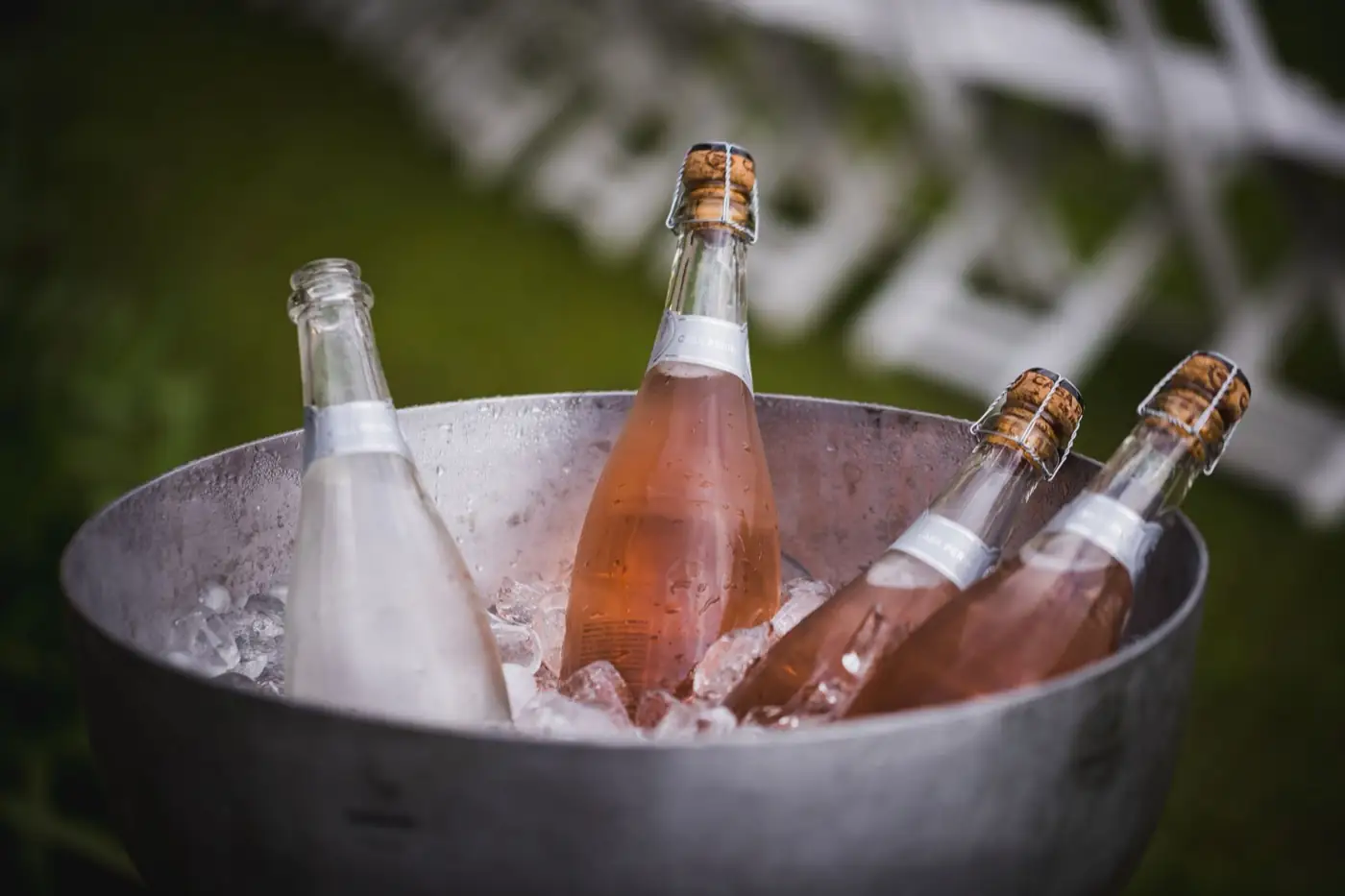
The 100-litre tub, half ice, half cold water, a handful of salt. Bottles submerged up to the neck, not resting on top.
Home fridge
Slow, and full from the first case. Keep it for the wine served last, the evening before.
Blast chiller
The caterer's or the venue's. Fast and clean, if you have access to it and it isn't full of desserts.
Cold room
The solution for large receptions: the wine arrives at the caterer's the day before and comes out at 8 °C. Then a tub to hold the temperature at the bar.
Serving temperatures
| Wine | Served at | The trap |
|---|---|---|
| Champagne, crémant | 6–8 °C | Lukewarm is guests' number one complaint. A tub is essential, before and during. |
| Dry white | 8–10 °C | Too cold and you can't smell anything; it warms up in the glass anyway. |
| Rosé | 8–10 °C | The first to run out, so the first out of the tub: restock every twenty minutes. |
| Light, young red | 14–16 °C | Ten minutes in the tub in summer. A red served at 24 °C tastes alcoholic. |
| Red for laying down | 16–18 °C | No ice, but not the car boot either. |
Ice cubes or a block of ice?
Ice cubes, and crushed ice if you can find it: the bigger the contact surface, the faster the exchange. A block of ice cools slowly and leaves pockets of lukewarm water between the bottles. Allow one two-kilo bag for four bottles, to be topped up halfway through when the ice has melted.
How far ahead should you start?
For 50 bottles with two tubs, an hour before the first glass: two batches of twenty-four at twenty minutes each, plus the time to fill. For 100 bottles, four tubs or the cold room the day before. The wedding wine page places this moment in the day; the one on wine for 50 guests gives the volume that goes with it.
Can champagne take sudden cold?
Yes, as long as it doesn't freeze: below −4 °C, the bottle breaks. Twenty minutes in a salted tub is safe; a night in the freezer is not. What damages it is the opposite: warmed up then chilled several times. Once out of the tub, it should be opened. The wedding champagne page and the one on champagne for 20, 50 or 100 guests give the quantities you will need to chill.
What if there is no water on site?
A wedding in a field, a hunting lodge: bring water containers, or ask the caterer for the cold room the day before and insulated cool boxes for transport. A well-closed cool box keeps bottles at 8 °C for four hours if it is full. Half empty, it lasts two hours. For a picnic with no fridge, the picnic and garden party page does the count for thirty people.